
The subject and power
"Power Ballad," now playing at a theater near you.

I nearly didn’t go see the new film “Power Ballad”, because it is set in part in Dublin Ireland, and I recently was rejected for a job in Dublin Ireland, so I thought looking at it would make me sad. And it did, but if I went through life ignoring all the places that don’t want me, I would have to become a hermit.
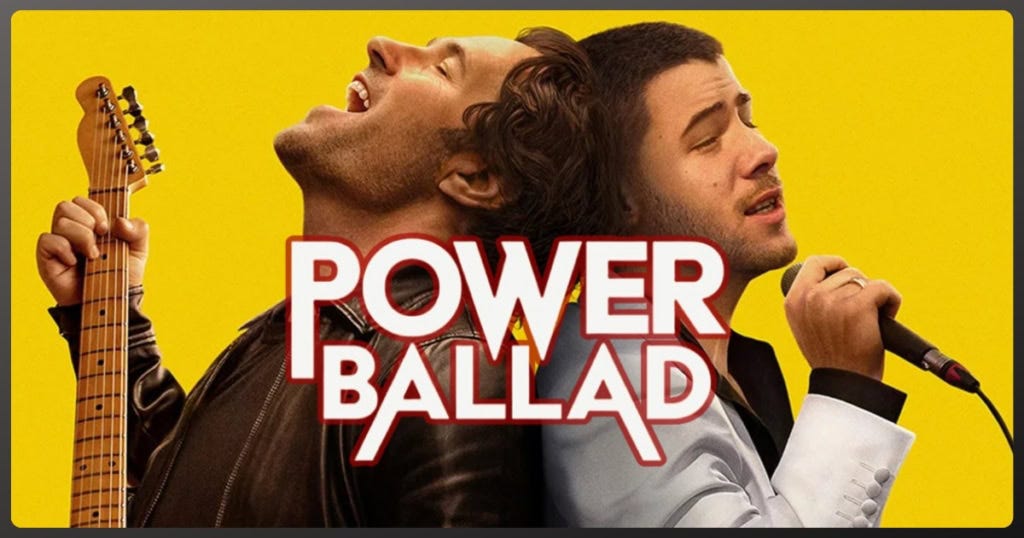
So I went, and I’m here to tell you, if you are an old person who likes classic rock music, this is a film that will go down easy. It’s got all the tropes we old people like in films about music, from the struggling artist to the evil music industry villains, and although those things are almost outmoded in today’s real world music industry, it’s still kind of fun to watch a fantasy flick about What It Used To Be Like.
So many movies are like this, I find. They are either about NOW and everyone in the movie is on their i-phone messaging or pinging people, or they are set before 2004, and thus the characters have to go to a lot more trouble to get things done. For example, my friend and I wrote a ticking clock screenplay about a road trip to see a band and we had to make sure it was set before the invention of the smart phone so that our girls could legitimately be broke, get lost, and end up sitting on the side of the road for a long time needing to be rescued.
It’s true of all media now but it’s especially true of movies about music, since the ‘before’ and ‘after’ of it is so stark. “Power Ballad” sits uneasily between the old world of music and the new one, because it’s about a washed up rock practitioner - played by Paul Rudd - who had dreams of stardom in the 80s or 90s (someone in the film mocks this era, as “whatever the hell that was about.”) But he lives in the here and now. So when the song that is the crux of the film’s plot goes viral, it gets “millions of streams” rather than sells a million copies - and honestly, that’s different, since there’s no real revenue in streams, and record companies aren’t quite like how they used to be either.
But movies like this have to suspend our disbelief a bit about things like that.
I actually expected a lot from “Power Ballad,” because it has a lot of elements I like, such as Dublin and Paul Rudd, and it also lacks things I don’t like, horror, super heroes, murders. I mean, yeah, it was smack in the genre of movies about Sad Middle Aged Men who somehow didn’t get their dream life because WOMEN. But this kind of movie almost has to be like that, because a) that was the era, and b) most movies that get made are written by men of that age. I’ve stopped being surprised or hurt by that, but it feels worth mentioning: as with life, everything is about men men men men men, and maybe if we’re lucky, how we ladies react to them. But just as with Dublin, if I boycotted that perspective, I’d get to see exactly nothing. Such is life.
Anyhoo. The main character, Rick Power, is in an Irish wedding cover band that plays familiar songs like Celebration and Man Eater (and of course “The Boys are Back in Town” because we are in Ireland, after all), and he perfectly dates himself by having named his daughter AJA. He is depicted as a family man with an orderly life and a house with a mancave in which he writes his own music, and a wife and daughter who sort of tolerate him because he is cute.
Being that kind of a man, he forces his 14 year old daughter to listen to his newest song, and she doesn’t like it. She says, “Dad, girls aren’t lonely now, we don’t like songs about being all lovelorn.”
“What do you want them to be about then?” he asks, and she responds: “Revenge.”
Ironically, the song he eventually writes that becomes a global hit is NOT about revenge, and IS about love, and there may be a message in that, as well. Movies about music always suffer from one main issue, which is that they are dependent on the song in question being great - or at least good enough to support the theory that it would be a world wide hit, earning its writer tons of money. The song that stands in for this is OK - good enough to support the premise I guess - but in a way, it also supports the idea that such songs are mostly popular because of their production values and who sings them. Even in this fictional universe, the only fanbase worth any actual money is for a brand, not a person, particularly not an old guy in his 40s, however cute. Here, the song is a hit for a Harry Styles-like boy band reject, played by Nick Jonas. I.e. a human brand.
Jonas’s character is actually the most interesting person in the film, and the most true to life. Rick Power is a fantasy good guy, but Jonas’s Danny Wilson is what actually exists in this world now: kids who have grown up famous, who have talent but no moral compass, and whose existence is so incredibly different from those of us in the real world that they cannot possibly relate to our problems. He reminded me a little bit of Liam Payne, the member of One Direction who had the least currency, and who leapt off a building in Brazil in despair last year. And he reminded me of, well, Nick Jonas.

Which is fine. In fact, juxtaposing a boy band reject and a wedding band has-been is quite clever; as it gets right to the heart of how the music industry works and two contrasting ways of commodifying music. “Power Ballad” insists that there is a third, more noble and satisfying, path, which is actual songwriting, and I guess that’s true, though it is hard to illustrate, narratively, the act of creation. In both “Deliver Me From Nowhere” and “Michael,” this is shown by the main characters staring intently at recording equipment and twiddling knobs. In this movie, at least, we see the two protagonists - or rather, the protagonist and antagonist - drinking and jamming together all night long, and we at least get a sense of how muddled-up the process is.
Both types of scenes, however, add to the idea the musical creation is some kind of magical alchemy that belongs to the past and not the present. Deep down we all know that AI is coming to get us, and music, so maybe movies like “Power Ballad” work because they allow us to think there is still some way to escape.
You've convinced me to check this movie out.
I love it when your essays bring me to appreciate creative work I would have never known about. You've been doing me this service for my entire life.