
Money Changes Everything
Bad Bunny at Superbowl Sixty, Feb. 8, 2026, Santa Clara, CA

It is a sad fact that when you’re a lowly adjunct professor like me, you seldom get to talk about your particular subject. But every now and then I jam in a lecture I call “Sports and the Spectacle,” in which I quote Guy Debord. “The spectacle,” he says, “is the other side of money,” and this year was a particularly rich moment for this lecture, because we had TWO such spectacles occurring on the same weekend, the Winter Olympics opening ceremonies, and the Super Bowl Half Time show featuring Bad Bunny.
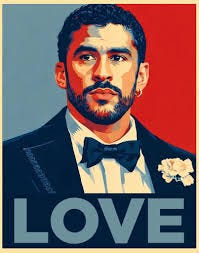
Too many people have now weighed in on the Bad Bunny moment for me to be able to add anything new to the discussion, but I did wonder what my man Guy DeBord would have said about that show. If the spectacle is, as he says, “The permanent opium war meant to make people identify…satisfaction with survival,” then what happens when the spectacle itself actually reenacts that equation in front of our eyes?
Because the Super Bowl Half Time show had a message to send to America, and by now, everyone knows what it was. I didn’t need to do a lecture on it for my students, because the facts behind the images spoke for themselves. Indeed, you could line them up by bullet points in a power point presentation and read them off, thusly:
--1898, Puerto Rico (PR) became a US possession solely so the US could invest in, exploit and profit on its sugar production…sugar, and the Caribbean, being one of the key commodities that supported slavery.
--Today PR has 3.2 million people, making it the 33rd most populous US territory, ahead of Nebraska, Kansas, North Dakota, etc. But its citizens have no representation in Congress and are disenfranchised from the Presidential election.
--In 2017, Hurricane Maria knocked out the power grid of the island and it has yet to be repaired.
Plus:
50 million Americans speak Spanish.
That’s pretty much all you needed to know to understand the subtext of the spectacle. That’s it.
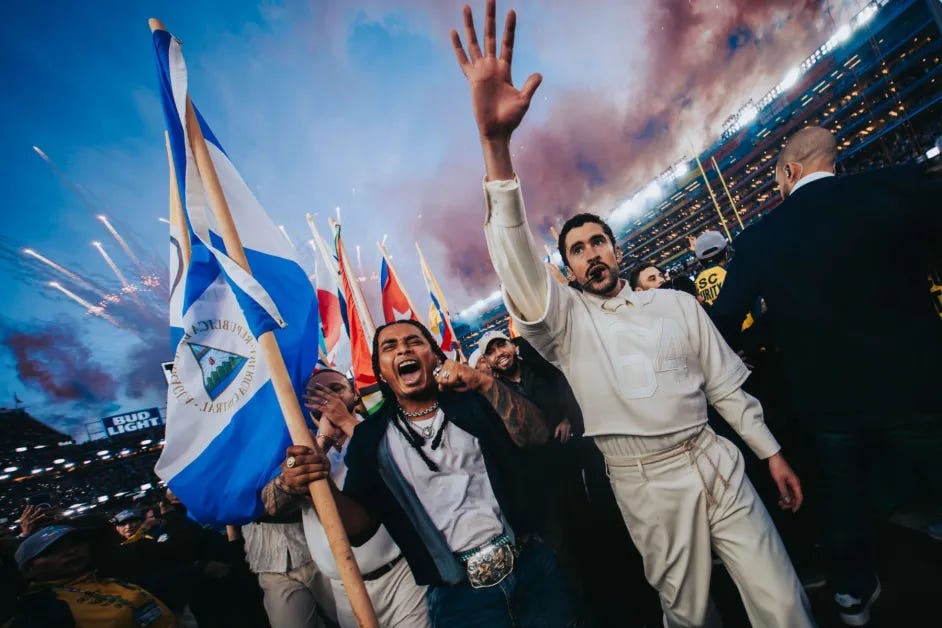
Despite apparent criticism in certain quarters, it should be said that everyone I knew or met or read actually loved Bad Bunny’s show, not so much because they love his music, but because the show expressed joy rather than fear, and joy is a much-needed emotion at this time.
It also acknowledged, or rather, made visible, a colonial history and culture that are currently under attack in our country, and that felt brave, and also relevant, in a way that Super Bowl Half Time shows generally don’t. Even Kendrick, whose show last year was also fantastic, felt like he was engaging in an argument that the people it was aimed at weren’t paying attention to.
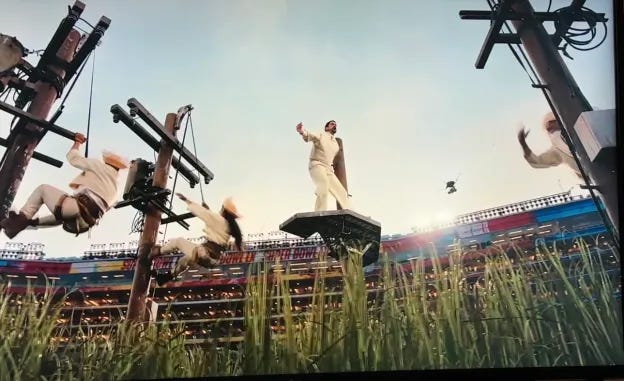
This one was different, perhaps because times are more desperate. I would also like to suggest that it was riveting because it was singular. Guy DeBord says that the spectacle is, “money one can only look at,” and its purpose is in part to hide the miseries of capitalism, but Bad Bunny’s performance somehow reversed that equation. From the people dancing on the sparkling power grids to the human sugar cane plants that turned the football field into a Caribbean plantation, this spectacle played with the notion of what and who gets to entertain who…and how.
One thing this performance reminded me of was the notion of “the white gaze.” This is something Toni Morrison has talked about, and it is the idea that the default reader or observer is coming from the perspective of someone who identifies themselves white. A place where you see it most clearly is in photographs in National Geographic, where the white man gazes on the non-white subject in ways that direct our thoughts to a white point of view, but it informs a lot of our cultural texts as well, particularly those proffered by people of color. Morrison has described it as a “little white man on the shoulder” that judges, checks, and validates, acting as a gatekeeper of narratives.”
The white gaze was entirely absent from the Super Bowl Half Time show, and that may be what unnerved so many people. Bad Bunny disregarded their version of events. He did not adjust his perspective, or his language, for a white audience, and that caused discomfort amongst people who have never felt in that position before. It wasn’t that they didn’t understand Spanish that really bothered them – I think everyone who has ever listened to heavy metal music, classical music, the Cocteau Twins or REMs early albums knows you don’t need to understand language to understand music – it was that they couldn’t understand a world that didn’t cater to their own vision of it.
Anyway, to have engaged honestly with Bad Bunny’s performance would have been to acknowledge so many uncomfortable things, and many people can’t do that at the moment. The show destabilized a particular world view, so no wonder some people squawked about it.
But then, the Super Bowl is also always a reminder of America’s essential isolationism. The truth is, no one in the rest of the world cares about tackle football, and even a lot of the people in the US don’t. Because I live in a super-rich community that happens to be right by the stadium, I know a number of millionaires who could easily have afforded tickets, and not one of them went to the Bowl because it’s such a niche interest. All my millionaire friends are either European-adjacent or women anyway, so of course they don’t give a damn. They are far more likely to watch the Olympics Opening Ceremonies, which conformed more to DeBord’s concepts.
Like the Super Bowl Half Time, it was intended to showcase a country’s culture. But wow, did it feel different. It’s aim, I am afraid, was more the one that Guy Debord would have attributed to it:
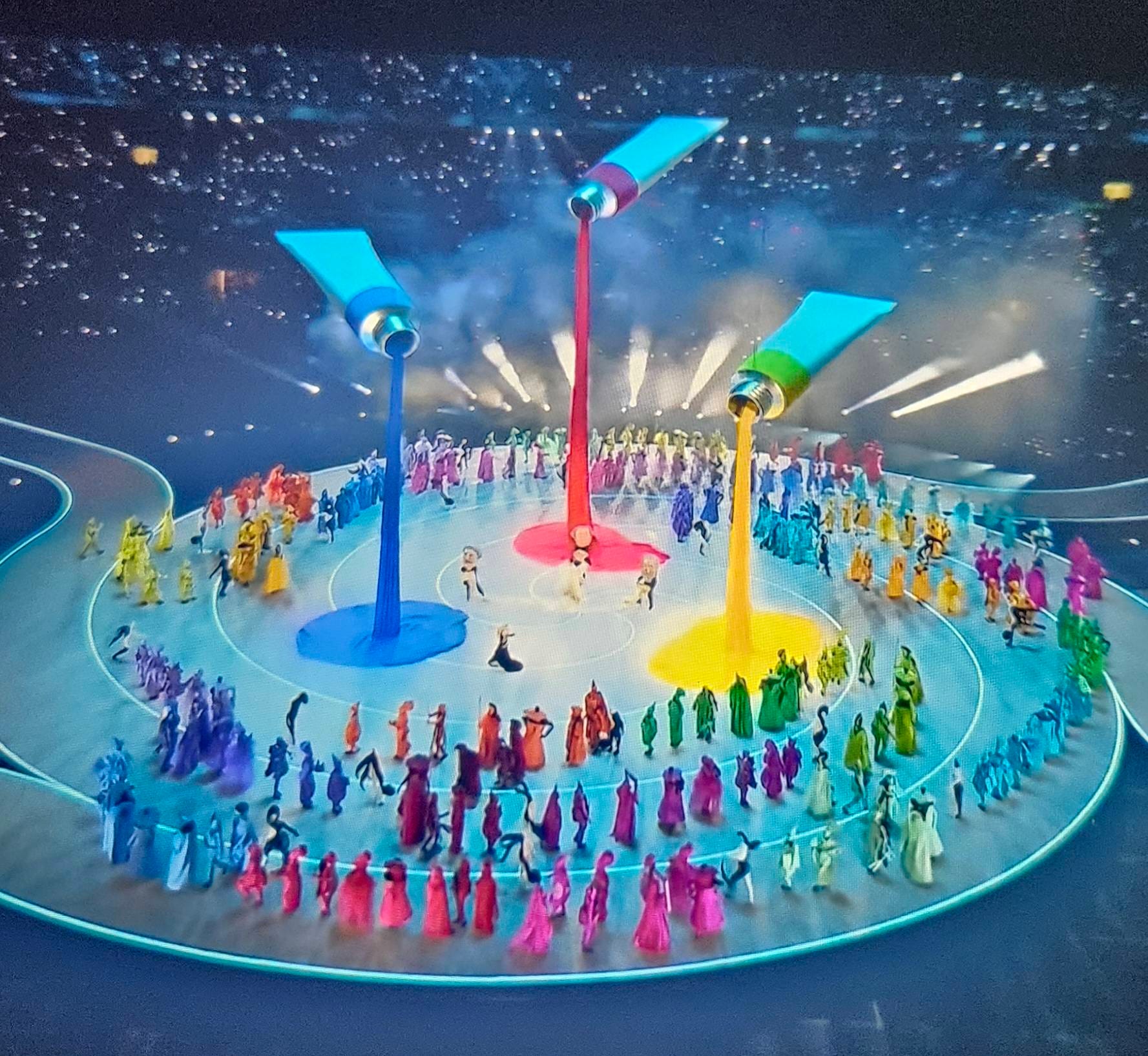
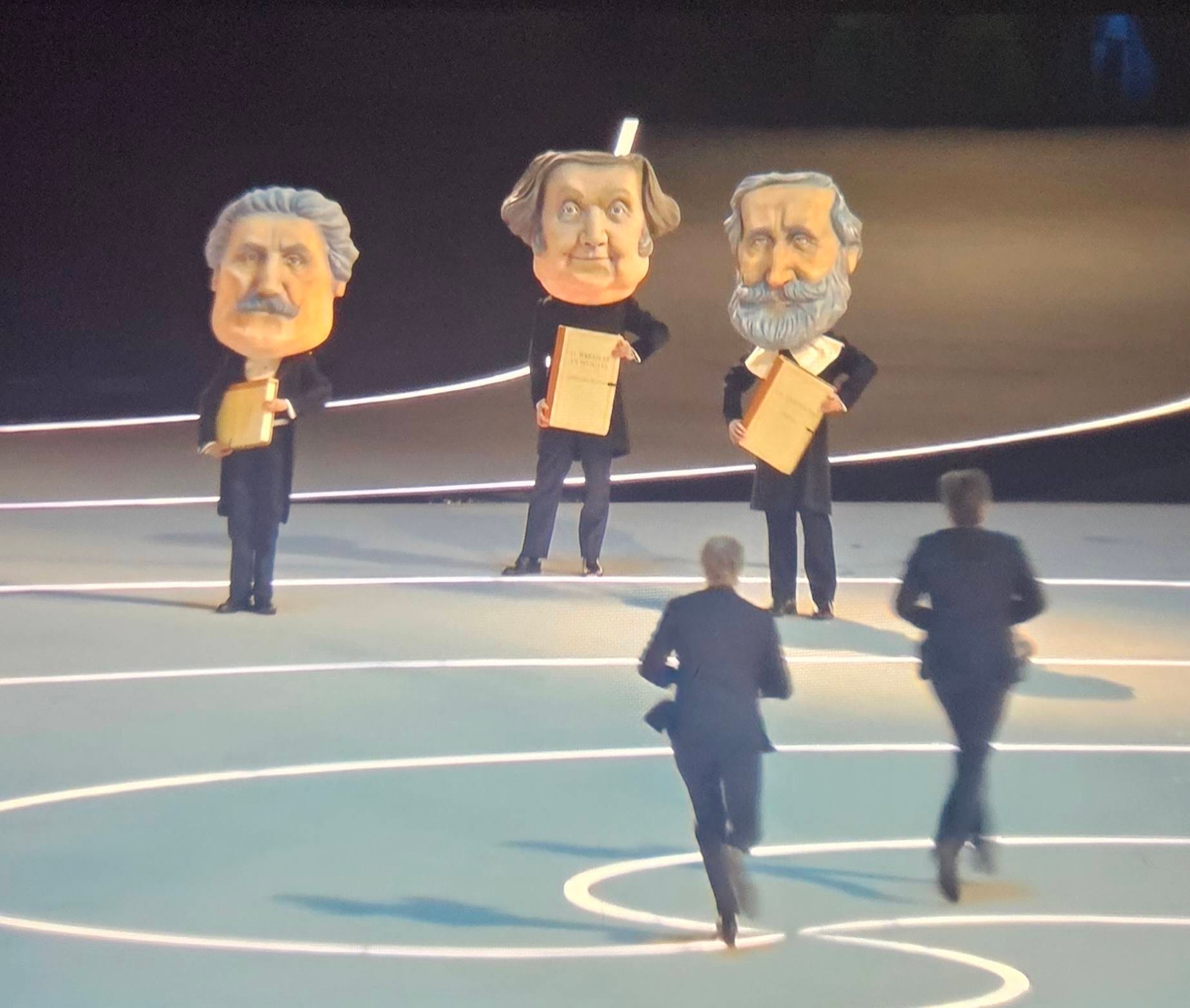
Debord: “The spectacle is nothing more than an image of happy unification surrounded by desolation and fear at the tranquil center of misery.” The Milano ceremony had its beautiful moments, but overall, the Canova-carved statuary that came to life, the enormous paint tubes squeezing paint onto the playing field, the dancing espresso pots and so on, all just ended up expressing the chaotic and messy nature of now. Why Mariah Carey? Why Charlize Theron? Who knows? Everything just seemed jumbled together. Even just eliminating televising the Oath ceremony seemed super symbolic, like the Olympics, or the media, were endorsing the lack of accountability which characterizes the current zeitgeist.
And then we had the baying, I mean booing, at the VP. I am old enough to remember when the world booed Russia at the Olympics, not the United States. But we are in our villain era – or rather, maybe we’ve always been, and it’s only now that the rest of the world feels comfortable telling us so.
Anyway, so much for this weekend’s TV viewing. Actually, I had to buy a dryer on Sunday and the appliance store I went to was across the freeway from Levi’s stadium. It was late morning on Sunday, and it was weird knowing that in a few hours the eyes of the nation would be focused on this exact location. This is what it looked like:
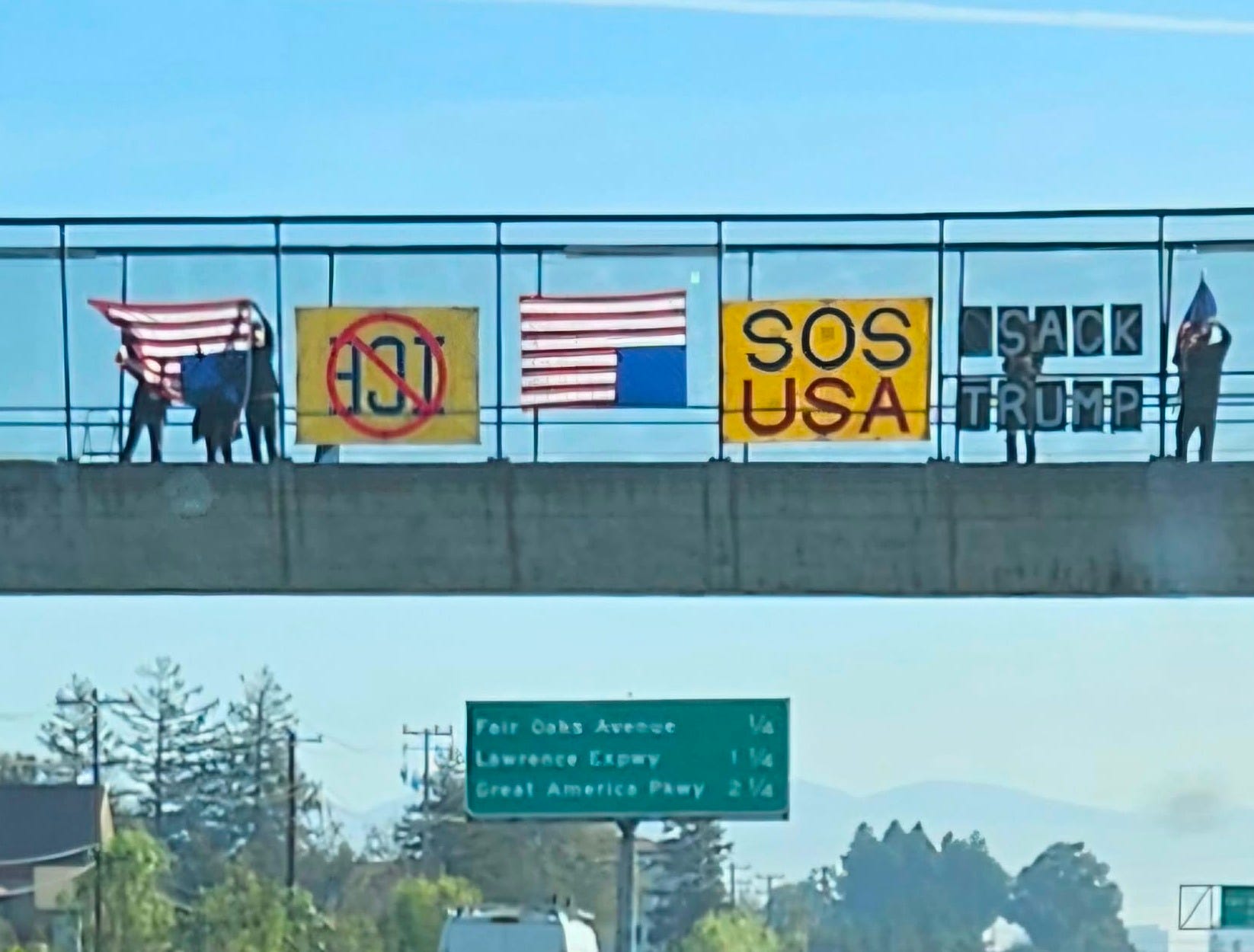
In the grand scheme of things, protest billboards on the freeway and the Superbowl Half Time shows aren’t going to change anything. Things got this way for a reason, and it’s not because of social media. But at least the baddest of the bunnies made us all feel better for a little bit, and sometimes that’s all you can hope for.
NOTE: Bad Bunny has a charity which supports young people in PR. It’s called Good Bunny and if you want to take a look at it, click here.

Despite saying you had nothing to add on Bad Bunny, you did. thanks!
Terrific piece, Gina!