
A gentle rain from heaven
BTS at Stanford Stadium, May 17, 2026

The night before I was going to see BTS play the second of three sold out concerts in my home town, I bicycled to the venue to check out the scene.
All day long the streets of my town had been overrun with the BTS Army. So-called soldiers in ripped tights and bunny-ear hairbands were sitting in long lines outside the Trader Joe’s eating pre-packaged salads. Groups of families identically dressed in BTS basketball tops were milling about downtown; svelte twenty-somethings with lilac-tinted hair wearing white minis and fur boots were mobbing the shopping mall, and lines and lines of people were walking in between the train station and campus on El Camino Real, threading their way in between many many little stands grilling delicious-smelling Mexican sausages.
On the corner by the High School stood the ladies of Indivisible in pink blow-up unicorn outfits. They were handing out voter pamphlets and registering people under a sign that read, “The Epstein Files Are Not in Iran.” Across the street, younger protesters flew Palestinian flags. Cops were directing the traffic flowing between the two sides, girls were handing out baggies of homemade pins, barrettes, and stickers, and as I was crossing, I overheard a teenager say to a very little boy wearing a Jimin T shirt, “Hey Jimin’s my bias too!” (In the Army, “bias” means your favorite member).
It was cool and funny and friendly and happy, and as I biked home I noticed that the stadium had started to glow a funny shade of green, like a spaceship about to takeoff.
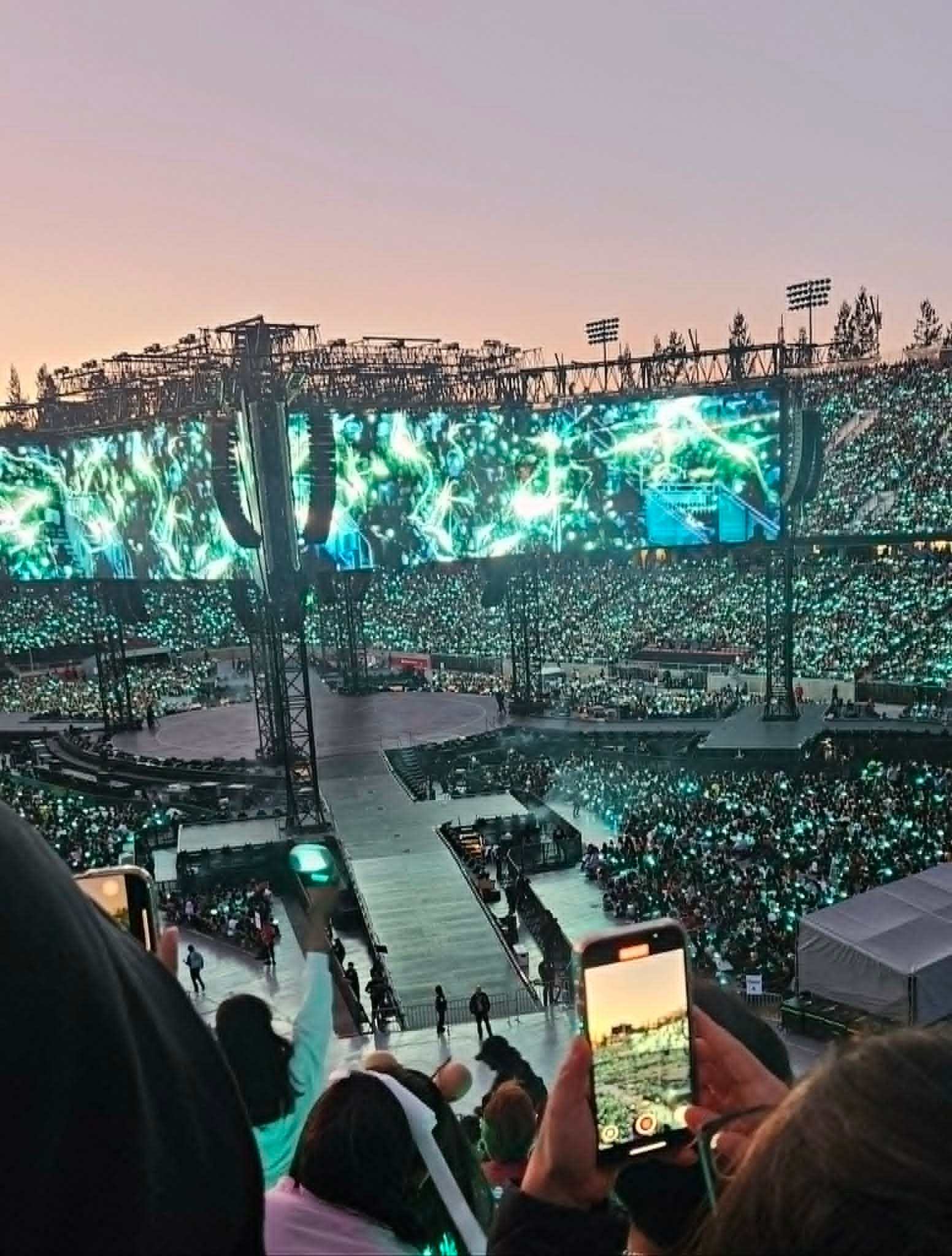
BTS were booked to play three nights in my town, at a venue - the football stadium - that is close enough to my house that you could walk there if you wanted to. A couple of days before the first show was scheduled to begin, some old curmudgeon wrote a grumpy post on Nextdoor.com complaining about the millions of trucks and the impending noise and chaos, and that person was ratio’ed to hell by the collective ire of every single one of her neighbors. The post’s been deleted so I can’t quote it directly but basically she was accused of being a wicked old witch who couldn’t bear to see kids having a little fun. “Oh, lighten up” was the nicest thing anyone said to her.
It’s easy to be cynical about this kind of this kind of thing, since the City of Palo Alto must have made absolute bank on the human influx, rivalled only by the vast sums taken in by the BTS merch booths that lined the stadium walk. AND YET. Capitalism notwithstanding, in a funny way, to me, BTS represents all that is pure and good and bright and kind in the global imagination.
When you see the audience shaking their light sticks in unison - light sticks that cost $68 each, and which light up together in sequence programmed by the concert -- it can feel like you are part of some kind of fantastical machine, a factory that churns out fans who’s sole purpose is to provide a background set...or worse, income.
But as I said to my friend Kammy as we were walking home through throngs of kids who were literally tear-stained with the dregs of their pleasure after the concert: who DOESN’T want to spend a few hours in the company of 50,000 people who are having the best night of their entire lives?
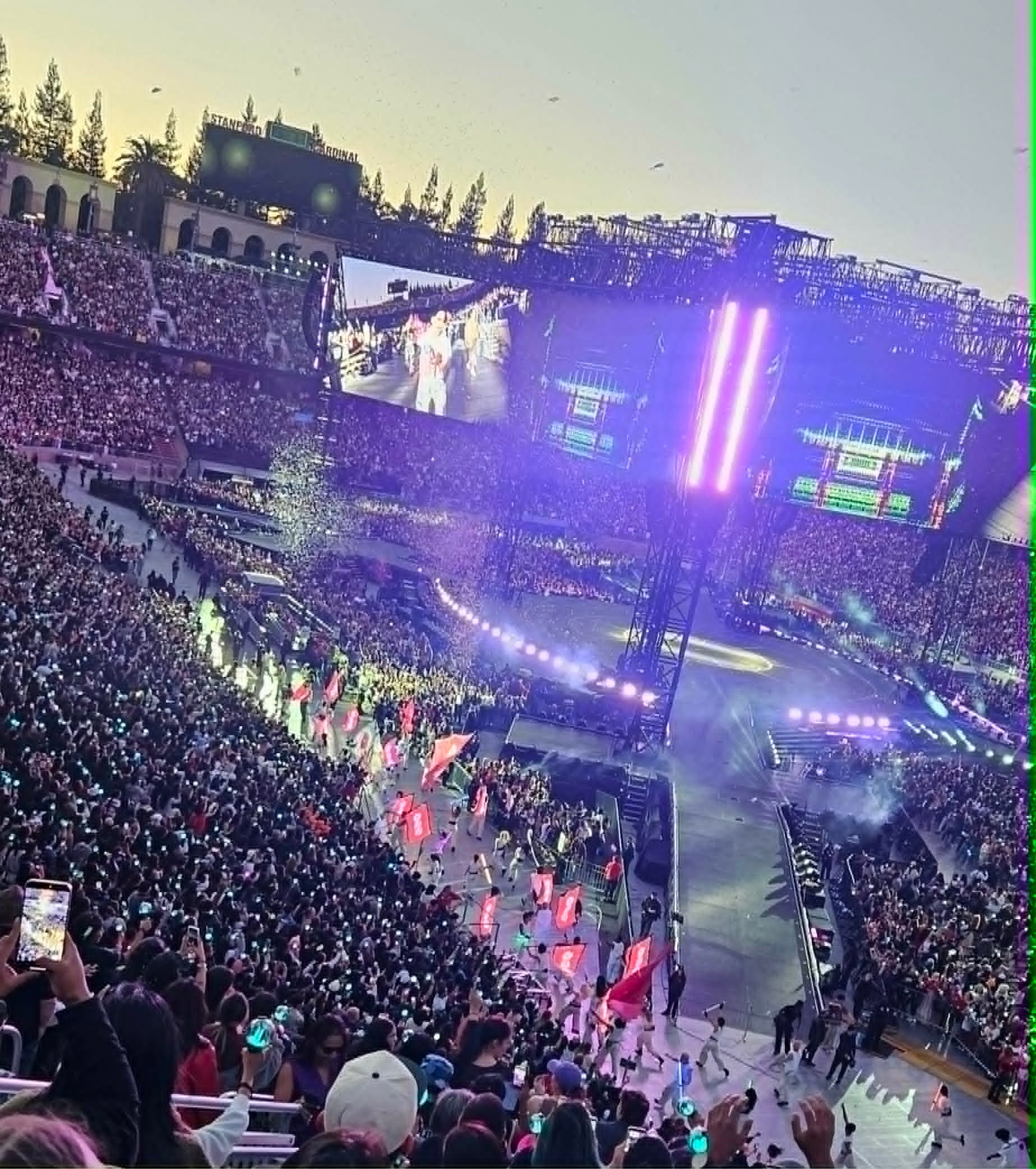
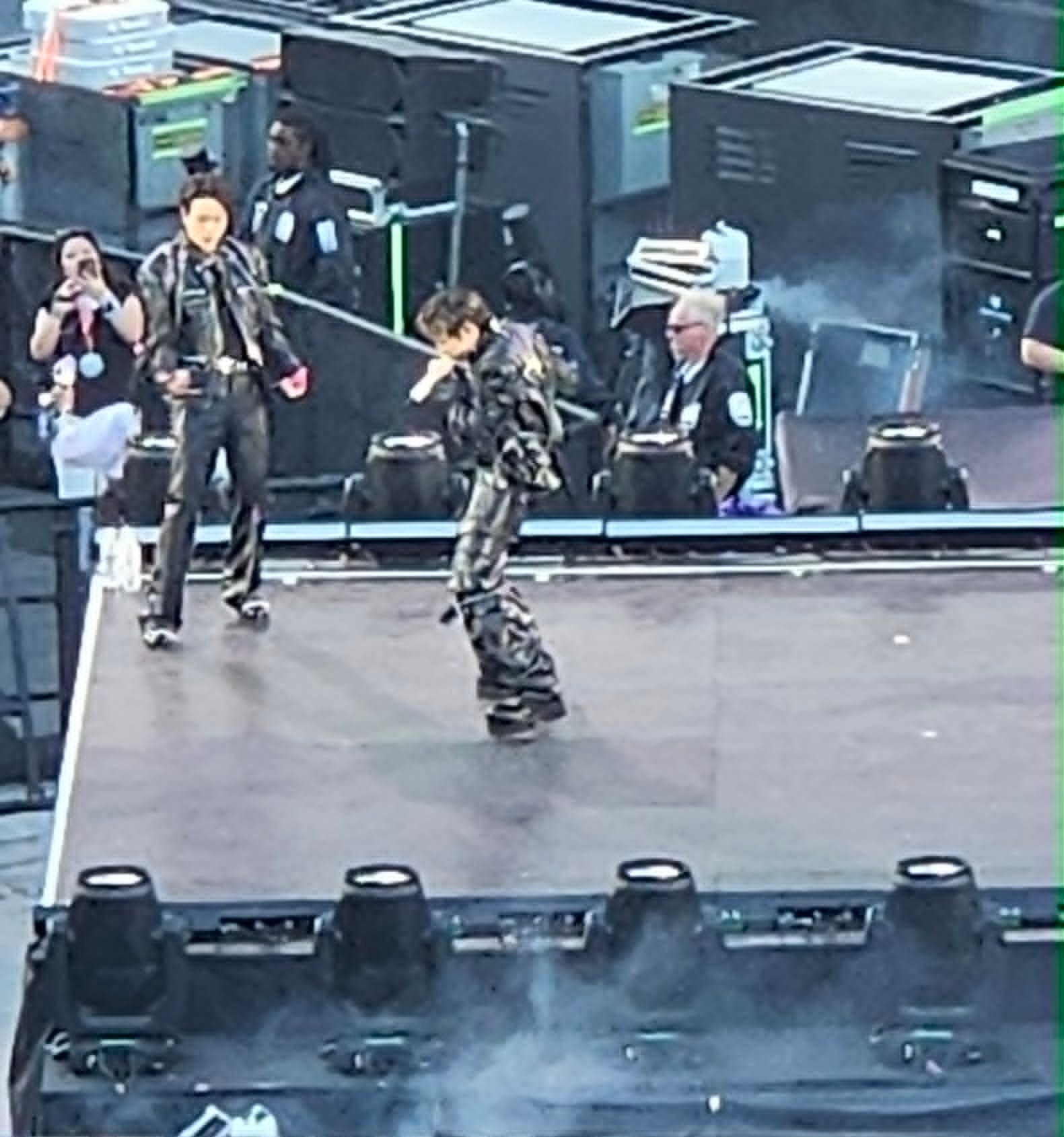
On Sunday night, BTS took the stage at 7:10 pm in more or less broad daylight, and I can only tell you the song they opened with (“Hooligan”) because I looked it up. I am unfamiliar with the latest album, Arirang, from which much of the set was drawn, and what old songs I knew (“Butter,” “Dynamite”) came very late in the set. It wasn’t at all like concerts I am used to seeing, anyway, because there was no band or instruments: rather, the group sang live (or possibly live-ish) to backing tracks, surrounded by dancers who Did Things while they did so.
BTS also danced, but a bit less than formerly: rather than the hypnotic precision formations I associate with them, they spotlighted their individuality and joked around with one another, freestyling and jumping on each other’s backs. Every time the camera framed one of them on the big screen 1/7th of the audience - for whom the showcased artist was their ‘bias’ or favorite - would scream its collective head off.
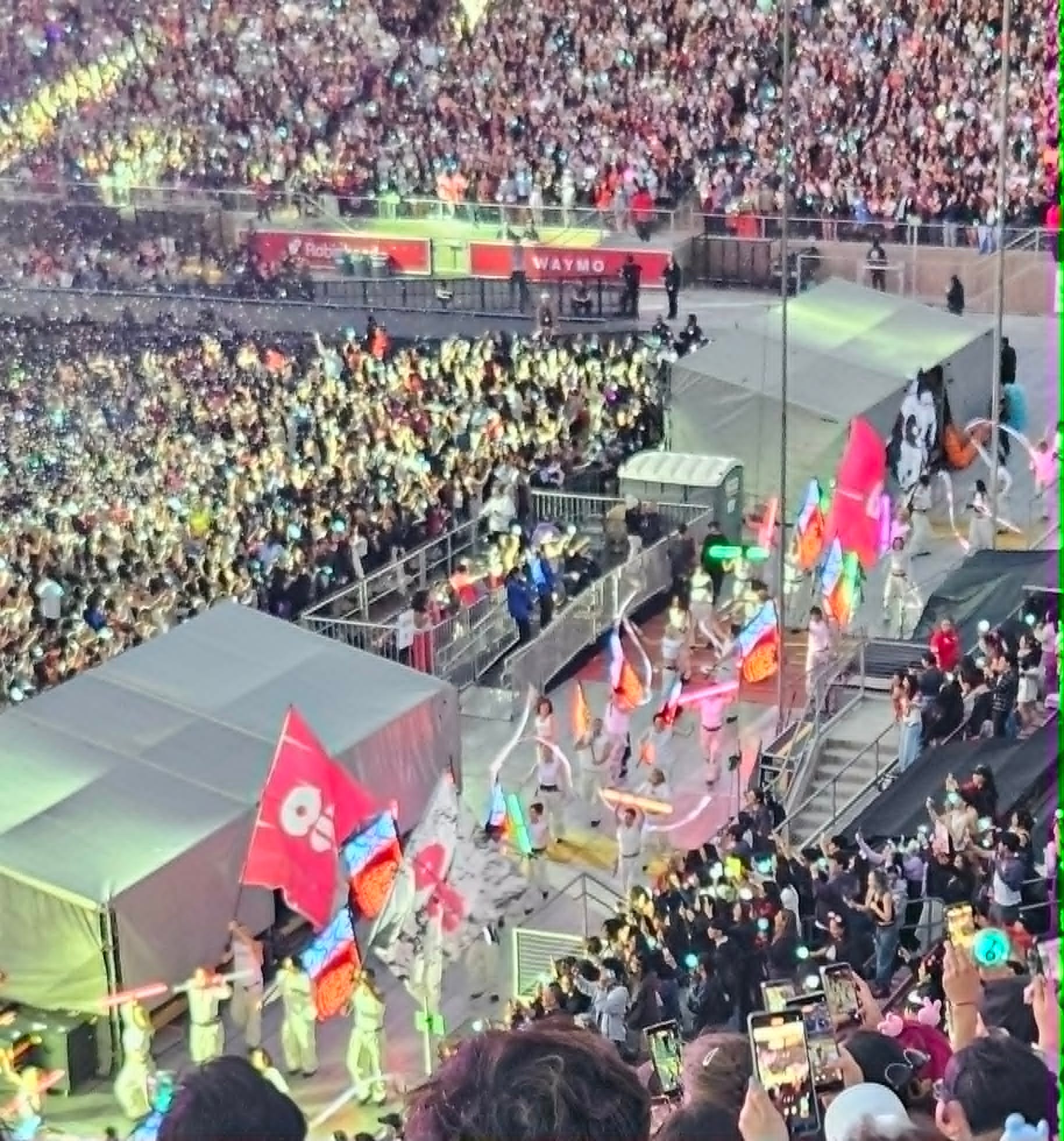
The set, which was in the round, had great sight lines. No one had a better seat than anyone else, and everyone was encouraged to interact with one another, or the video, rather than with the people on stage. Mostly people just danced in their seats, shaking their light sticks, but there were some memorable moments, such as when the band, followed by their dancers, formed a parade and marched all the way around the arena track, and when they set off confetti, and it filled the sky like colored snow, falling, like mercy, upon the place beneath.
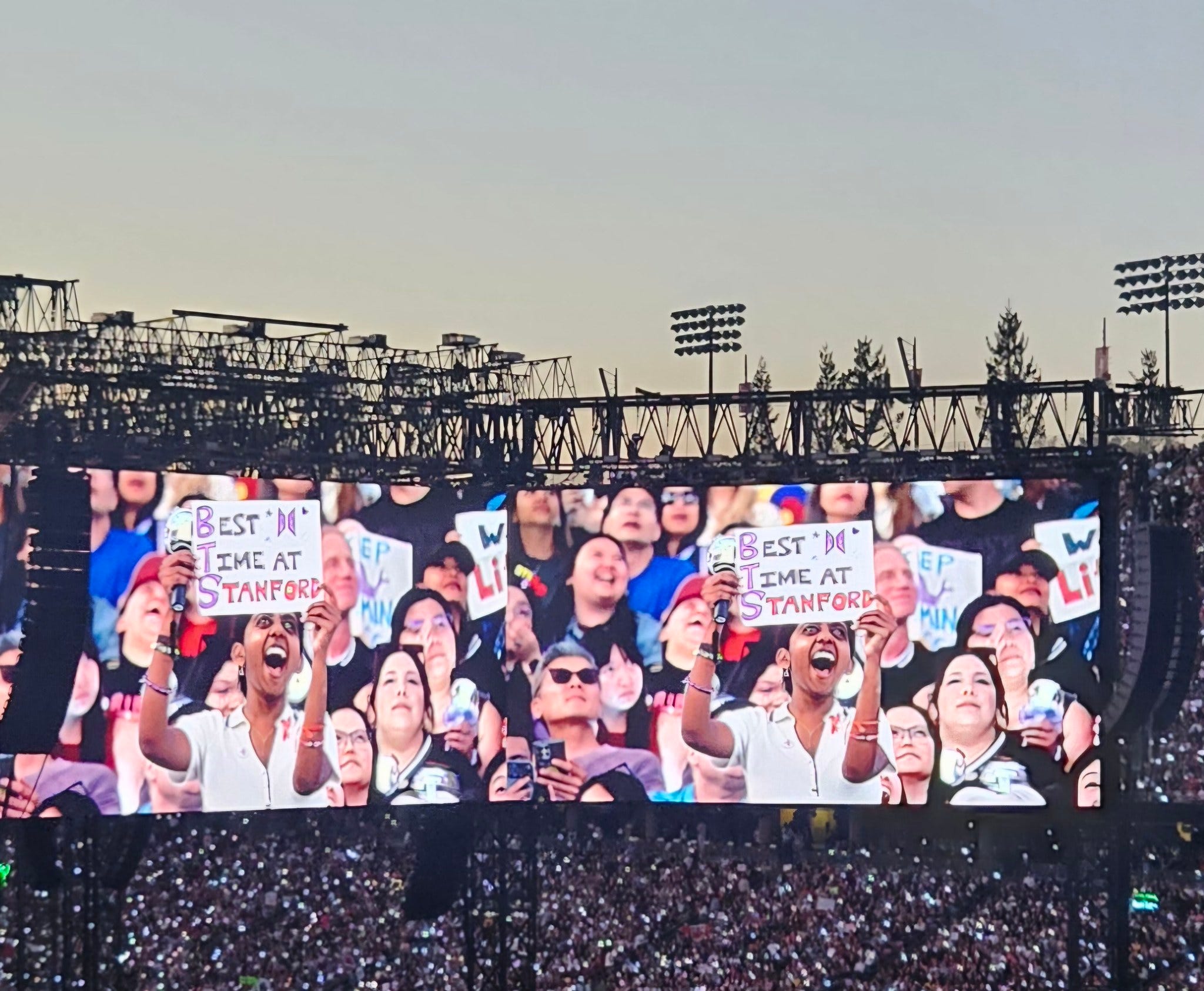
The show split itself into three acts, with breaks between each one, and a thing I especially enjoyed was when they were off stage and the cameras roamed the stadium, throwing up on the big screen the signs and costumes of audience members. Some were children holding signs that said things like, “My name is HOPE and I love BTS!” (One of BTS members is called J-Hope). Another little kid’s sign said: “In the Army since BIRTH”.
Some were calls outs to songs or biases, but others just called out their extreme happiness of being there. One sign said, “Life Can Be Fun!” Another said, tellingly: “Finally I am home.”
In his Nobel Prize winning book “Crowds and Power” (1960), which was the basis of my PhD dissertation and book, Elias Canetti writes of crowds which are contained in stadiums or other buildings thusly.
“The closed crowd renounces growth and puts the stress on permanence…It creates a space for itself which it will fill. This space can be compared to a vessel into which liquid is being poured and whose capacity is known. In this way the crowd sacrifices its chance of growth, but gains in staying power. It is protected from outside influences which could become hostile and dangerous and it sets its hope on repetition. It is the expectation of reassembly which enables its members to accept each dispersal. The building is waiting for them; it exists for their sake and, so long as it is there, they will be able to meet in the same manner. The space is theirs, even during the ebb, and in its emptiness it reminds them of the flood.”
Clearly those words describe the BTS crowd, and who can blame them for wishing to shut out a hostile and dangerous world? There are people who say that KPOP is appropriative and, but I am not sure that’s true: there is something about the way the band members interact with one another, something about their particular sense of humor, which is super Korean, deeply attractive and also, very much not American, diverging from American pop, rap, and r & b in the same way that Miyazaki’s children films differ from Disney’s. There is a relationship between BTS and western boy bands, but they aren’t quite the same thing.
Besides, the one overwhelming point that stood out was that the concert arena radiated joy. BTS may be a factory bent on generating fans, cash and attention, and its metaphor for itself may be disturbingly military, but at least it is an army which is non-patriarchical, gender fluid, LGBTQ friendly, age non-specific, and on the side of justice…as when, for example, in the year 2020, the BTS Army mobilized to book themselves all the free tickets to rightwing rallies across America...and then just didn’t show up, leaving the arenas half empty.
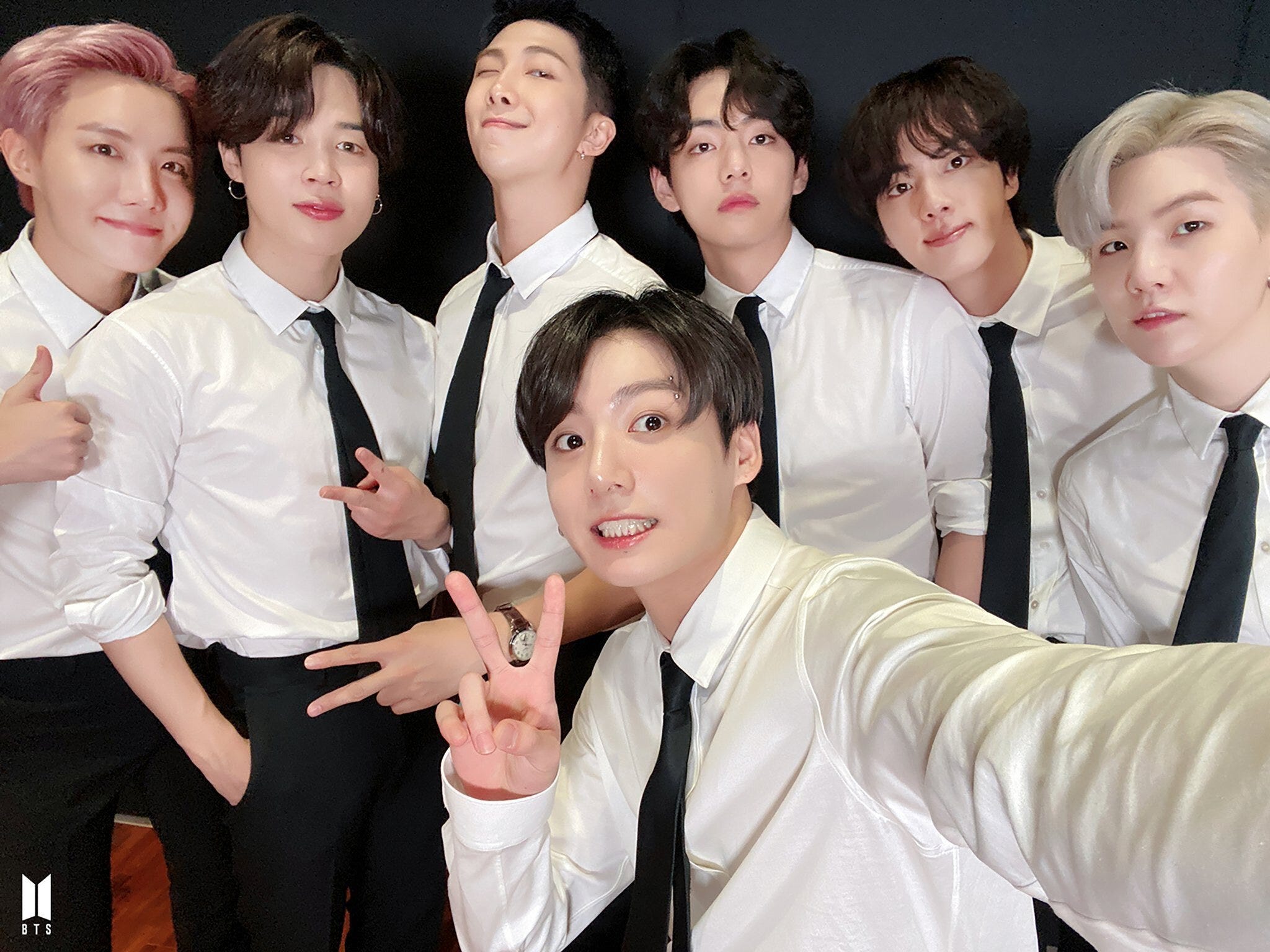
Sad to say, in the end, the only thing I don’t really like about BTS is the music. I don’t dislike it, but it doesn’t really move me. On the one hand, I am of an age to find aggression-less rap songs to be soothing rather than toothless, but I am also exactly the wrong age to be slain by the gorgeousity of the performers with their unreal good looks and super polished movements. To me, they seem like robots, or anime characters come to life - which is of course the whole point. To young people, that’s what’s great about them, but to me it is merely spooky.
That said, I do recognize the power of a boy band, the power of a fandom, and the power of crowds in general (see: Canetti). And even though I am not a huge fan of KPOP music, I do love things from Korea, and here’s why: from 2008-2011, I spent three summers in a row teaching a class in Seoul to Korean high school seniors on their way to the states for college, and it was easily the highlight of my entire time in graduate school. Ooh, how I loved living in and teaching in Seoul: the hilarious kids I taught, the wonderful walks I took, and the blazing fast internet in the safe and cool subway...the coffee shops, the pajama-and-umbrella kiosks, the little notebooks with silly sayings on them...it practically hurts me to remember it all now. I can remember how I was reading Cloud Atlas, still my favorite reading experience of all time ever, and how we would go to the local Noraebang after work and sing stupid songs at the top of our lungs, and how, when I got back to my hotel, I would order up a plain baked potato from the Outback Steakhouse that was in the basement of my lodgings.
But I didn’t eat it with butter, because butter was so expensive there - $8 for a tiny cube.
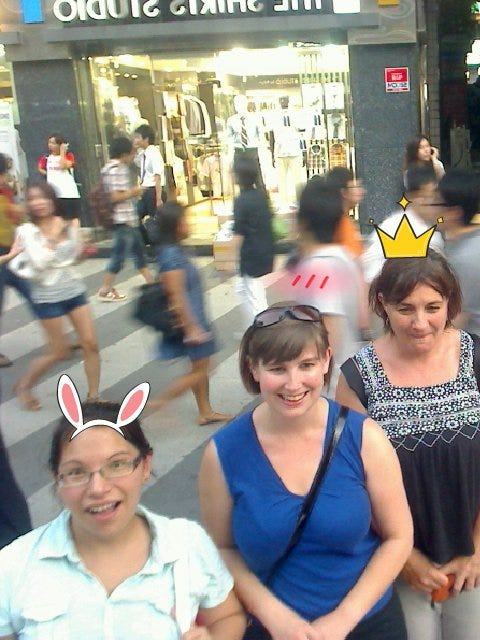
BTS (who began in 2009) reminds me of those glorious summers, just as I am reminded whenever I taste kimchi, or hear cicadas, or smell hot rain on cement in the middle of a summer downpour. Some Saturdays, I would walk around the Olympic Park listening to the tinny sound of K-pop which would be blasted from tiny speakers hidden in the shrubbery, and some evenings in Gangnam I would come upon a K-pop band performing impromptu on a makeshift stage for all the kids who were milling around shopping and eating donuts. (American donuts were a craze that year.)
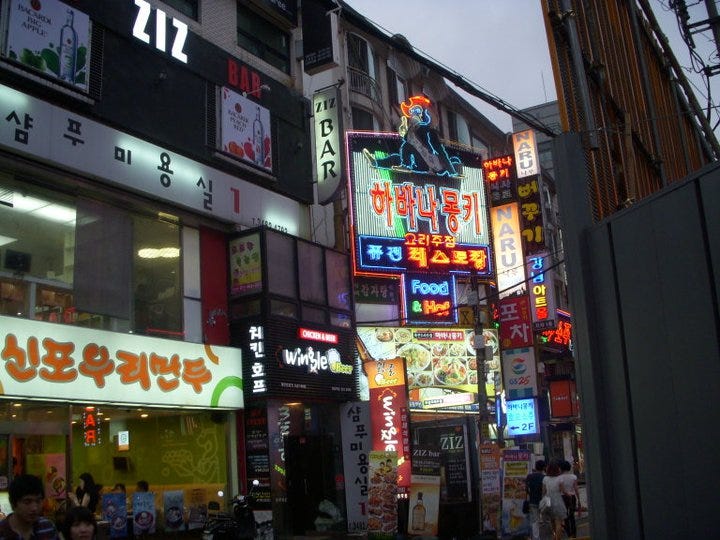
In the years I spent in Seoul, K-Pop was already huge in Korea, but not so much in the USA, where it was still just a subculture. Bands like Super Junior, Girls Generation and Big Bang were bigger than BTS then, and I was dying to go to a KPop concert, but like seeing a baseball game, it was a little beyond my ability to get to one. Fast forward fifteen years, and here I am, at my very first, and I know full well I am late for the party: BTS are just having a victory lap. I have a 25 year old friend had tickets for all three nights, and she is probably typical in that she loved them as a teenager and now has the money to buy her own tickets.
For her and those like her, this tour is really BTS nostalgia, a night for the longtime fans, as J-Hope said in his little impromptu speech, ‘make happy memories;’ after all, the title of their latest album is Arirang, a word that in Korean means something exactly like that. Arirang is also the title of Korea’s most famous folk song and it invokes longing, love, enduring hardship and Korean history. I think that is the proper word for the feelings that BTS invoked in me, and maybe everyone else in that stadium, as the fireworks popped off. Arirang, arirang, aririyo: 청청하늘엔 별도 많고 우리네 가슴엔 꿈도 많다 .