
Mystery Train
The film "Elvis Presley In Concert" and the book "Mystery Train" at 50 in conversation.

Last weekend I drove to Los Gatos to see the afternoon showing of a movie about Elvis Presley. In the theater, there were many other old people, and they chattered beforehand to each other about all the great rock shows they had seen. I heard someone bragging about having seen Santana at Shoreline Amphitheater, as if that was some kind of accomplishment. It made me think again about how seeing live music is, for many, the most important and special days of their lives. For many, just being in the same room with the people making the music is such a thrill. And of course, there’s the music itself. Never discount the music.
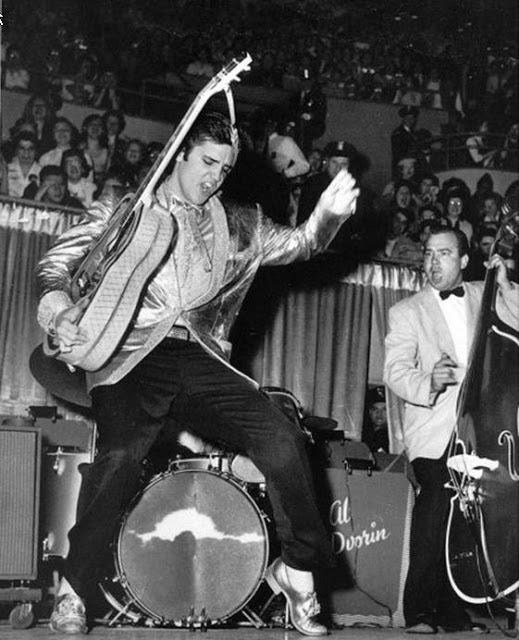
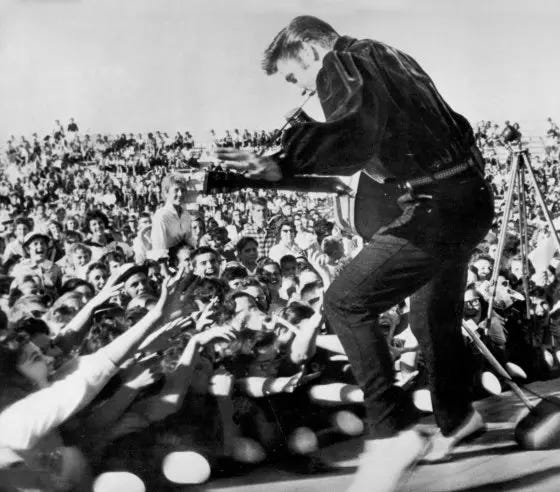
The film, titled EPiC for “Elvis Presley In Concert,” really gets that idea. Directed by Baz Luhrmann, it is an amalgam of two previously released, but remastered, live Elvis concerts from the early 1970s Elvis: That’s the Way It Is (1970), and Elvis on Tour (1972), as well as never seen before footage of rehearsals for those concerts that was discovered in a salt mine in Kansas. It has all been restored, edited, and then overlaid narrative taken from many released and unreleased interviews with the King, and it shows indubitably how seeing Elvis – or loving him, I should say -- was about a lot more than just his songs. The first twenty minutes in particular, a compendium of clips of his career from 1954 to 1956, when he was drafted, captures the frenzy and excitement and the absolute modernity of what he was doing, the ground that he broke, the intensity of the feelings he churned up, the cultural chasm he rent in the fabric of the 50s. It shows why, when Elvis Presley died, in 1977, the critic Lester Bangs wrote a piece about him in which he famously stated, “We will never agree on anything the way that we agreed about Elvis.”
But did we? The film’s clips from interviews with Elvis emphasize the way the mainstream media, to quote a review I read by Sheila O’Malley, didn’t interrogate Elvis at the time so much as litigate him. Sober commentators ask him time and again if he is sick of rock, ashamed of rock, and if, upon his return from the Army, he would be, in essence, willing to put away his childish things. Is the era of rock almost over, someone asks him. Elvis, unruffled, answers: “It won’t be over until they find something awfully good to replace it.”
Well, they didn’t.
When you’re a college professor, every year the kids know fewer and fewer of your points of reference. One by one they fade, like Cheshire cats, and you can no longer expect them to know who REM, U2, or even Richard Nixon, is. This year my students didn’t know of the cartoon “Recess,” and quite a few haven’t even read or seen Harry Potter. Someone I know was also complaining that their students no longer know who Elvis is, but that isn’t quite as jarring, given that his heyday – 1955- 56 – was 70 years ago. 70 years prior to when I was in college, commercial radio hadn’t even been invented yet.
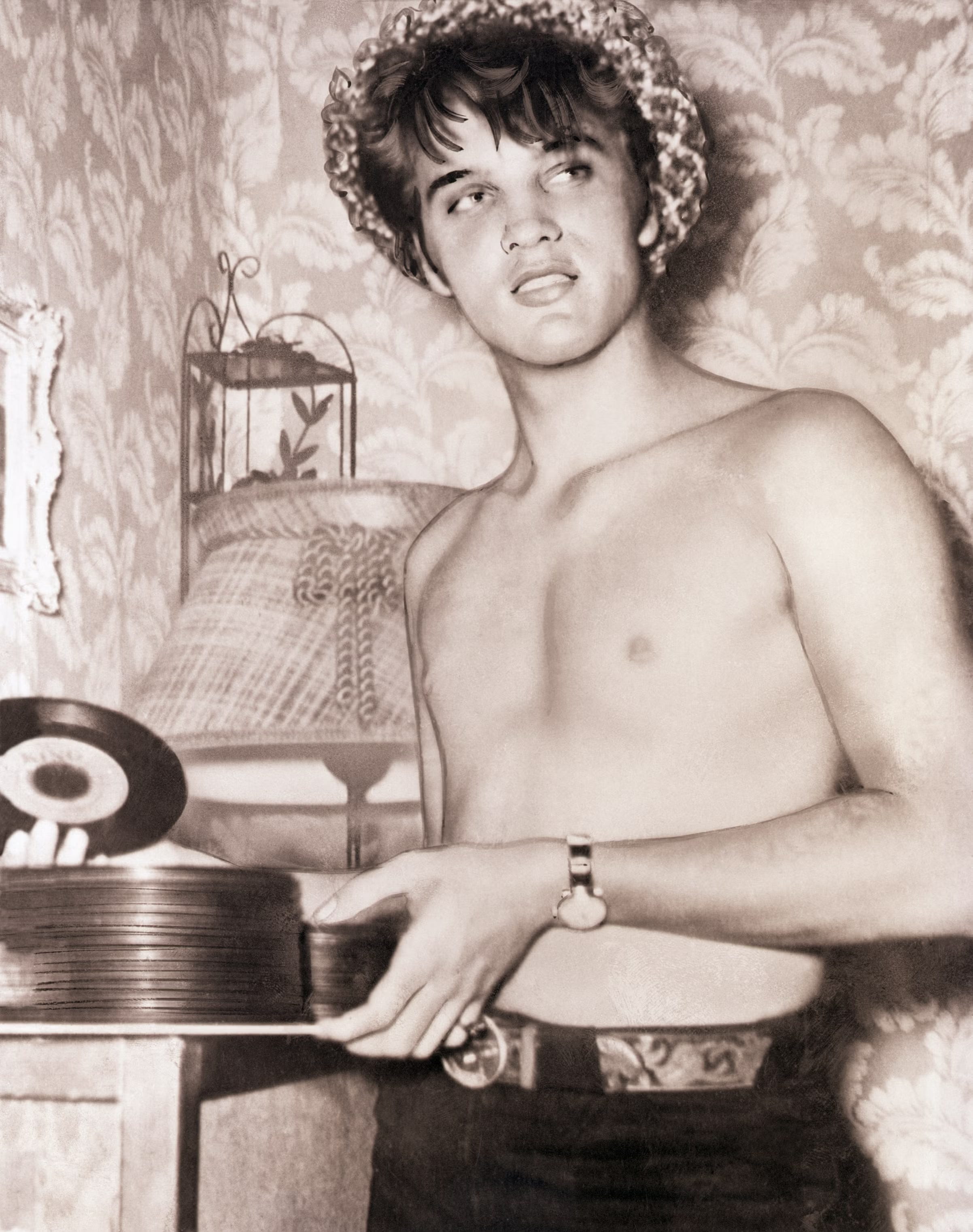
Elvis was still very, very famous when I was little, but to me he was an ugly old fat guy in a white jumpsuit, a joke. My parents didn’t listen to his music – actually, they didn’t listen to any music. And when he died, I just thought, what’s the big deal, he is OLD.
He was 42.
It’s important to remember that age gap when you’re watching this movie, because it really comes off like ancient history. In fact, I always watch movies like this with an eye towards whether my daughter would like it, and for the first twenty minutes I thought she would. It did a fantastic job of explaining the cataclysmic effect of Elvis on culture itself and how, to quote Bangs again, “he gave us all an erection of the heart.” But it may be that there are two types of Elvis fans, the type who enjoy his music and then the type, like me, who were influenced by Greil Marcus’s description of his music in his monumental book “Mystery Train.” I felt about the book the same way as the critic Dwight Garner, who says in the introduction to a new, 50th anniversary edition: “It reverberated in my young mind like the E major chord that ends the Beatle’s A Day In the Life.”
“Part of Elvis’s achievement, Marcus saw” (Garner continues) “was to plant new questions, over a thousand radio transmitters into the American mind. “Why not trade pain and boredom for kicks and style? Why not make an escape from a way of life…the question that trails off the last page of Huckleberry Finn – into a way of life?”*
This is, of course, no longer a fashionable way to think about Elvis Presley – if one even thinks about him at all. For years, probably since rap was invented, many people have thought that he epitomizes the popular music bent towards appropriating and monetizing black music, and while this is not to say his work didn’t do that, the montage argues that there is something a lot more intense going on. Sure, his oeuvre took songs like ‘Hound Dog” and “That’s Alright,” and presented them appealingly to white audiences. But there is another argument to be made that a) given the history of white appropriation, if it wasn’t him it was definitely going to be someone else and b) he did something else entirely - something unique -- in addition. In a way he presaged hiphop’s seminal invention of the mashup. In the film we see him singing gospel with his band and one immediately understands just how much his weird mishmash of that genre with dirty blues was a) original b) sacrilegious and c) just so much fun.
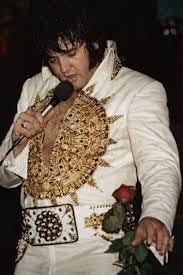
By the early 70s, when the rest of the film takes place, that sense of danger, wonder, and modernity surrounding Elvis Presley had completely receded, and from here on in it might be hard to make a case for this movie to the younger set. It’s replaced by something else, something tacky and vulgar, something inherently empty and maybe even incoherent, but also very singular. This is the Elvis that Greil Marcus captures so well in the first part of the chapter of “Mystery Train” on Elvis, when he says, “History without myth is surely a wasteland; but myths are compelling only when they are at odds with history. When they replace the need to make history, they too are a dead end, and merely smug. Elvis’s performance of his myth is so satisfying to his audience that he is left with no musical identity whatsoever,.”
EPiC captures this Elvis, the smug one whose version of America is contained in a trilogy of songs meant to sum up all of American history - “Dixie,” “The Battle Hymn of the Republic,” and the slave song “All My Trials.” It is, as Greil tells us, as if “the culture he has made out of the blues, las Vegas, gospel music, Hollywood, Schmaltz, Mississippi and rock n’ roll can contain any America you might want to conjure up…Elvis recognizes that the Civil War has never ended, and so he will perform the Union.”
And it is, he adds, a complete illusion. No one can reconcile American history to itself, but the attempt that Elvis made is pretty amazing, even if its dénouement was a tragedy. Well, especially if its dénouement was a tragedy. Because, to quote the book again, “Compete assimilation really means complete acceptance. The immigrant who is completely assimilated into America has lost the faculty of adding whatever is special about himself to his country; for any artist, complete assimilation means the adoption of an aesthetic where no lines are drawn and no choices are made.”
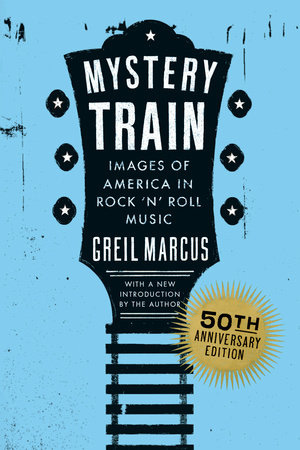
“Mystery Train” is now 50 years old itself, but unlike EPiC, it feels as contemporary as the first day I read it. It is surprising to realize that when it was written, Greil was only 30, Elvis was still alive, and most astonishing of all, the distance between early Elvis (Good Elvis, if you will), and the then-current Elvis, the one Greil describes here, was only 20 years, i.e. the same distance as between now and 2006, the year that “Mr. Brightsides” and “Hollaback Girl” were hits, the year that the first Taylor Swift album was released.
“Mystery Train” has amazing insights into what is important about Elvis Presley and about the invention of rock and its incredible effect on the 20th century and the American psyche. When I first read it, I bought those insights whole hog, and I still do. And yet, both then and now, watching this film, I was still kind of felled by the aesthetic shipwreck that Elvis became. He himself is still beautiful beneath his weird hair and makeup, but the music can’t overcome the sight of his gestures and his clothes: the overall effect of the awful haircut and the white jumpsuit and the bedazzled belt buckles and the gaudy jewelry and most of all the capes is just very shocking. Clothes may not make the man, but I simply cannot get past them when they are on Elvis’s body. Everything he means or could have meant is obliterated by the vision of his beautiful container stuffed into those terrible, terrible garments. They may as well be blackboard erasers in how efficiently they are able to remove all trace of who he is, was, and still could be.
But erasure-via-vulgarity may be the perfect prism in which to regard Elvis’s legacy. At this particular juncture in history, everything we ever thought about creating, upholding, establishing, escaping or imagining America has been sunk in a similar mire. Indeed, it seems almost right and fitting that the brightest emblem of 20th century America would be crushed by the weight of sheer tackiness, for that is what one sees going on in current culture, be it Mar a Lago or AI slop. Elvis always was ahead of his time.
*At the end of the novel, Huck has decided to go West. “But I reckon I got to light out for the Territory ahead of the rest, because Aunt Sally she’s going to adopt me and sivilize me, and I can’t stand it. I been there before.”